
TIG WELDING SERVICES
Argon-shielded arc welding of sheet metal parts and structures
according to customer drawings
PRITZ DEVELOPMENT carries out TIG welding when manufacturing metal parts,
housings, assemblies and structures from carbon steel, stainless steel, aluminium and its alloys.
The process is used to produce precise, high-quality welded joints, particularly when welding
thin-walled sheet metal components and products with increased requirements for weld appearance and
leak tightness.
TIG welding is part of the full PRITZ production cycle: laser cutting, CNC punching, metal
bending, welding, surface treatment, powder coating and assembly of finished products.
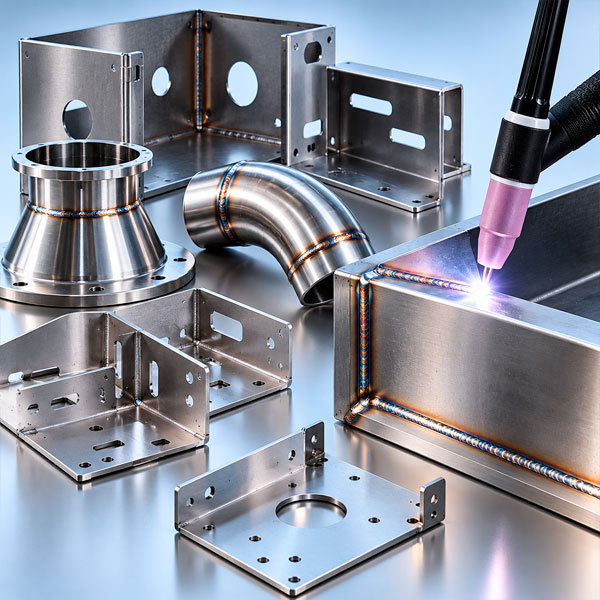
Characteristics of the TIG process
TIG (Tungsten Inert Gas) is an arc welding process under inert gas shielding, mainly argon. The process uses a non-consumable tungsten electrode. The electric arc between the electrode and the part being welded melts the metal in the joint area. Welding can be performed with or without filler material. Shielding gas prevents oxidation of the molten metal and ensures welding process stability.
TIG welding under argon shielding allows precise control of heat input, the formation of visually appealing welds and the joining of thin parts.
TIG is particularly suitable for welding stainless steel, aluminium and products where surface quality, precision and minimal welding spatter are important.
Materials and process selection
TIG welding of aluminium
When joining aluminium alloys, we select welding parameters and filler material according to the
alloy grade, thickness and joint geometry. This applies to housings, brackets, panels and components
made from aluminium profiles, among other products.
TIG welding of carbon steel
For carbon steel, the method allows precise joints to be made in metal parts and equipment components.
We select the scope of work according to the thickness, joint design and strength requirements.
TIG welding of stainless steel
TIG welding is used for stainless steel and acid-resistant steel where appearance, leak tightness
and surface quality are important. The steel grade and product operating conditions determine the
requirements for filler material and joint preparation.
TIG welding of brass
The feasibility of welding brass depends on the specific alloy grade and joint design. The presence
of zinc can make the process more difficult and promote weld porosity. We assess the suitability of
TIG and the feasibility of carrying out such an order individually after analyzing customer documentation.
Products for which TIG welding is used
The process is used to manufacture sheet metal parts and structures requiring visually appealing
welded joints, accurate geometry and high surface quality.
Main types of products:
- Stainless steel products — housings, guards, panels, tanks and industrial equipment components.
- Equipment housings and guards — thin-walled welded structures, protective guards and metal modules.
- Leak-tight structures — tanks, trays, containers and housings with specified joint leak tightness requirements.
- Aluminium parts — housings, brackets, panels and welded equipment components.
- Retail and furniture equipment — decorative components, support frames, stands and structures with visible welded joints.
- Components for food processing and process equipment — stainless steel parts with increased requirements for weld quality and surface treatment.
TIG is most effective for thin sheet metal products, short and complex welded joints, and structures where weld quality takes precedence over welding speed.
Is gasless TIG welding possible?
TIG requires a shielding gas, most often argon, that protects the electrode and the molten metal. Welding without filler material, described for this method, also involves a gas shield.
Advantages of TIG welding
- Heat input control. We adapt welding parameters to the material and component thickness to limit distortion and achieve the required joint geometry.
- High weld quality. The ability to produce even, visually appealing joints with minimal spatter.
- Precise process control. Adjusting the welding current and filler material feed allows control over weld formation.
- Thin sheet metal welding. The ability to join thin parts with correctly selected parameters while minimizing thermal distortion.
- Material versatility. The ability to weld carbon steel, stainless steel, aluminium and a range of other metals and alloys.
- Surface quality. The absence of a slag layer and minimal metal
The ability to produce leak-tight joints. The process is suitable for manufacturing products requiring leak tightness, provided that the welding procedure is followed and the necessary inspection is carried out.
Process limitations
When selecting TIG, the characteristics of the welding process should be considered:
- Lower productivity. Welding speed is usually lower than with MIG/MAG, particularly when making long welds.
- Higher labour costs. Longer welding times and welder qualification requirements increase the labour intensity of production.
- Sensitivity to part preparation. Contamination, oxide layers and inaccurate edge fit-up can negatively affect joint quality.
- Thermal distortion. Despite the ability to control heat input precisely, there is still a risk of warping when welding thin sheets.
- Limited efficiency with thick sections. When welding heavy parts and long welds, the process is often less productive than MIG/MAG.
The choice of TIG depends on the material and part thickness, as well as requirements for appearance, leak tightness, strength and production costs.
TIG welding within the PRITZ production cycle
PRITZ DEVELOPMENT carries out TIG welding as part of comprehensive metal product manufacturing according to customer technical drawings and documentation.
Combining laser cutting, sheet metal bending and welding allows housings, guards, tanks and assemblies to be manufactured with a minimal number of intermediate production operations.
Production planning takes into account welded joint design, surface quality requirements, access to welds, assembly sequence and possible thermal distortion.
Depending on the requirements for the finished product, welding may be followed by weld cleaning and grinding, surface treatment, powder coating and final assembly.
Why PRITZ DEVELOPMENT
Series production repeatability
Stability of dimensions, geometry and product quality across successive batches.
Full production cycle
Core metalworking operations are carried out within a single production process.
Working from customer documentation
Production is organized based on agreed drawings and technical requirements.
Production of pre-series batches
Before launching regular production, the manufacturing process and product can be checked using a limited batch.
ISO 9001
A quality management system with a valid certificate.
Headquartered in Poland
PRITZ DEVELOPMENT is headquartered in Katowice and focuses on cooperation with B2B customers in Poland and the EU.
Order TIG welding
Manufacture of welded parts and structures according to your drawings
Send drawings, 3D models or a technical specification indicating the material, part thickness, welded joint requirements and batch size.
PRITZ DEVELOPMENT specialists will assess the manufacturability of the design and the suitability of TIG, and prepare a commercial quotation taking into account the technical requirements and production volume.