
STEEL CASTINGS
Manufacturing of steel castings weighing from 10 to 1500 kg according to the customer’s
technical drawings
PRITZ DEVELOPMENT produces custom castings in carbon steel and low-alloy steel.
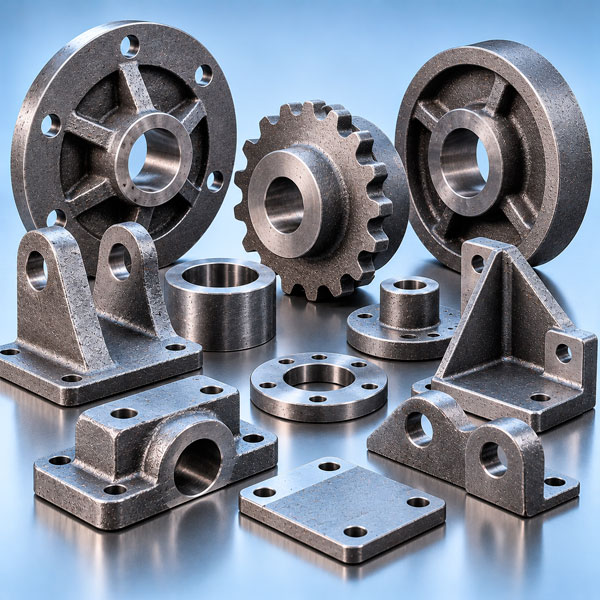
Steel casting allows the production of parts with complex geometries, including housings, supports,
brackets, heavy structural components and machine parts with internal cavities.
PRITZ provides technical support during order fulfillment, arranges subsequent machining and delivers
finished parts in accordance with customer requirements.
Technical capabilities
Materials:
- Carbon cast steel.
- Low-alloy cast steel.
Material selection takes into account the operating conditions of the part, required mechanical properties and chemical composition. When requesting a “steel casting”, specify the particular cast steel grade and the requirements of the technical documentation.
Enquiries about stainless steel castings require a separate assessment of manufacturing feasibility, taking into account the material grade and project requirements.
Manufacturing processes:
- Casting in sand moulds.
- Casting in moulds made from cold-setting, self-hardening mixtures (no-bake).
- Casting in metal moulds (permanent moulds).
Casting moulds and cores are prepared taking into account the part geometry, required internal cavities and metal solidification conditions.
Additional operations:
- Design and manufacture of pattern equipment and other foundry tooling.
- Casting cleaning and removal of gating systems and risers.
- Heat treatment.
- Turning, milling and boring.
- Dimensional inspection and verification of material properties.
- Non-destructive testing in accordance with the requirements of the technical documentation.
Casting is particularly effective for parts with complex three-dimensional geometries, internal cavities, thick sections and high mechanical strength requirements.
What products is steel casting used for
Steel casting is used to manufacture parts for industrial equipment operating under significant mechanical loads, as well as components with complex geometries that are difficult or not economically viable to produce using other metalworking methods.
Main product types:
- Equipment housings — housings for reduction gearboxes, bearing assemblies, drives and industrial mechanisms.
- Bases and supports — heavy machine bases, stands, support plates and structural components.
- Mechanical transmission parts — hubs, couplings, gear blanks and other drive system components.
- Load-bearing structural components — brackets, levers, connecting assemblies and machine parts subjected to loads.
- Components for pumping and power equipment — housings, covers, flange components and other parts.
- Parts for transport and lifting equipment — supports, travel mechanism components and load-bearing assemblies.
- Spare parts for industrial equipment — cast blanks and finished parts for machine repair and modernization.
Advantages of steel casting
- High mechanical performance. The ability to produce strong parts made of carbon and low-alloy cast steel with specified properties.
- Complex geometry. Manufacturing parts with stiffening ribs, projections, internal cavities and complex surfaces.
- Wide weight range. The ability to produce both relatively small and heavy castings.
- Reduced number of assembly joints. A steel casting can replace a structure consisting of several welded or mechanically joined components.
- Suitability for heat treatment. Adjusting the microstructure and mechanical properties of cast steel in accordance with product requirements.
- Flexible production volumes. One-off and series production are possible using sand moulds and cold-setting, self-hardening mixtures.
The casting method is selected based on the part design, cast steel grade, requirements for accuracy and mechanical properties, and batch size.
Process limitations
The following characteristics must be taken into account when designing steel castings:
- Casting shrinkage. Shrinkage occurs during the solidification and cooling of cast steel and must be taken into account when designing the mould, gating system and risers.
- Potential casting defects. The risk of shrinkage cavities, porosity, non-metallic inclusions and cracks requires adherence to manufacturing procedures and quality control.
- Design limitations. Wall thickness, smooth transitions, draft angles and metal solidification conditions must be taken into account.
- The need for machining. Achieving accurate seating dimensions, holes and mating surfaces usually requires additional machining.
- Tooling costs. The manufacture of patterns, core boxes and other tooling components affects the cost of the order.
- Duration of the production cycle. Tooling preparation, mould production, pouring, cooling, cleaning and inspection require appropriate processing time.
Manufacturing steel castings
PRITZ DEVELOPMENT manufactures steel castings according to the customer’s drawings and technical documentation.
At the order preparation stage, we analyze the proposed steel casting in terms of its design, material requirements, dimensional accuracy and mechanical properties. We take into account dimensional tolerances and surface quality requirements.
The manufacturing process is selected with regard to technical requirements. We determine the casting method, whether pattern equipment needs to be prepared, and the scope of heat treatment and machining.
PRITZ coordinates the production process, including casting manufacture, additional operations and verification of finished parts against customer requirements.
Typical production process sequence:
Drawing analysis → Process selection → Tooling manufacture → Casting → Cleaning → Heat treatment → Machining → Quality control → Delivery of finished parts.
A steel casting can be supplied as an unmachined blank or a fully machined part, ready for further assembly and use, depending on the scope of the order.
Why PRITZ DEVELOPMENT
Series production repeatability
Stability of dimensions, geometry and product quality across successive batches.
Full production cycle
Core metalworking operations are carried out within a single production process.
Working from customer documentation
Production is organized based on agreed drawings and technical requirements.
Production of pre-series batches
Before launching regular production, the manufacturing process and product can be checked using a
limited batch.
ISO 9001
A quality management system with a valid certificate.
Headquarters in Poland
PRITZ DEVELOPMENT is headquartered in Katowice and focuses on cooperation with B2B customers in Poland
and the EU.
Order steel casting
Manufacturing of steel castings and finished parts weighing from 10 to 1500 kg according to customer drawings
Send technical drawings, 3D models or a technical specification stating the cast steel grade, part weight, required quantity and requirements for machining and quality control.
PRITZ DEVELOPMENT specialists will carry out a technical assessment of the order, agree on the manufacturing process with the foundry and prepare a commercial offer. The casting quotation takes into account part complexity, batch size and the required additional operations.