
SPOT WELDING SERVICES
Spot welding of sheet metal and metal structures according to customer
drawings
PRITZ DEVELOPMENT carries out custom spot welding when manufacturing metal housings, guards, panels,
brackets and sheet metal subassemblies.
The process allows metal parts to be joined in lap joints without filler materials or additional
fasteners. Resistance spot welding is particularly effective when manufacturing structures from thin
steel sheets with a large number of repeated joints.
Spot welding is part of the full PRITZ production cycle: laser cutting, CNC punching, sheet metal
bending, fusion welding and resistance welding, surface preparation, powder coating and assembly
of finished products.
Characteristics of the spot welding process
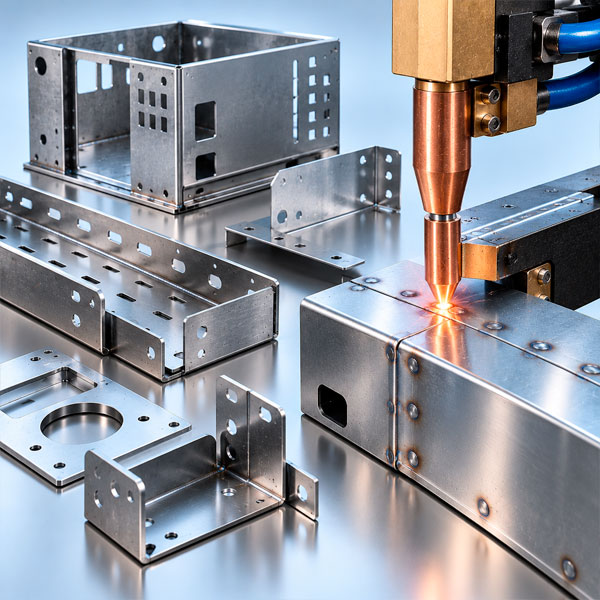
Resistance spot welding (Resistance Spot Welding, RSW), also referred to as resistive spot welding, is a metal joining process that uses heat generated by the flow of electric current and electrode pressure.
Electric spot welding involves overlapping the sheets to be joined and clamping them between the electrodes of the spot welding machine. A high current flows through the joint area. Electrical resistance causes localized heating and melting of the metal at the interface between the sheets, where a weld nugget forms.
After the current is switched off, the metal solidifies under electrode pressure. A spot weld is formed, creating a strong permanent joint.
The process requires no welding wire, shielding gas or flux. Joints are formed at individual points without creating a continuous weld.
The process is most commonly used to weld low-carbon steel sheets. With appropriate process parameters and equipment, stainless steel, galvanized sheets and aluminium alloys can also be spot welded.
Parameter selection includes the welding current, current flow time and electrode force. The material, thickness and number of sheets being joined, their surface condition and joint geometry are also taken into account. Electrodes are selected according to the material, required weld size and access to the joint.
Products for which spot welding is used
The process is used to manufacture thin sheet metal structures designed with lap joints and without requirements for joint leak tightness.
Main types of products:
- Equipment housings and guards — joining panels, internal partitions, reinforcements and mounting components.
- Electrical cabinets and enclosures — fastening internal components, mounting plates and frame parts.
- Metal furniture — cabinets, shelves, drawers, runners and structural components.
- Retail and warehouse equipment — shelving units, stands, metal panels and assemblies.
- Refrigeration and ventilation equipment — housings, guards, panels and HVAC system components.
- Brackets and fastening components — joining sheet metal blanks, reinforcing plates and mounting components.
Sheet metal products manufactured in series — parts and subassemblies with a large number of identical resistance-welded joints.
Advantages of spot welding
- High productivity. The short spot weld formation cycle provides high joining speed, particularly in series production.
- No filler materials. Welding requires no wire, shielding gas or additional fasteners.
- Reduced distortion. Localized heating affects a small area, helping to limit distortion of thin sheet metal parts compared with making long welds.
- Joint repeatability. Correctly selected and controlled current, welding time and electrode force parameters allow repeatable welds to be produced.
- Limited subsequent processing. The process produces no slag and, with correctly selected parameters, limits molten metal expulsion, reducing the scope of surface cleaning.
- Cost-effectiveness. High welding speed and the absence of filler materials reduce the labour intensity of manufacturing products in series.
Process limitations
When selecting spot welding, the following characteristics should be considered:
- The need for a lap joint. Standard resistance spot welding is not intended for butt joining sheet metal parts.
- Access from both sides. In a standard setup, electrodes must access the joint from both sides. Product geometry must allow them to be positioned correctly and apply pressure.
- Lack of leak tightness. Individual spot welds do not form a continuous, leak-tight joint.
- Material thickness limitations. The permissible thickness of the sheets being joined depends on the equipment capabilities, material, number of sheets and selected process parameters.
- Electrode marks on the surface. Localized indentations may remain after welding and must be considered when manufacturing decorative products and parts with visible surfaces.
- Joint design requirements. The number, diameter and placement of spot welds must correspond to the applied loads and product strength requirements.
The choice of spot welding depends on the material, sheet thickness, part geometry, joint strength requirements and production volume.
Spot welding within the PRITZ production cycle
PRITZ DEVELOPMENT carries out sheet metal spot welding when manufacturing metal parts and assemblies according to customer technical documentation. Technical drawings provide the basis for establishing part geometry, weld placement and requirements for the finished product.
The process complements MIG/MAG, TIG and MMA welding, as well as laser welding, allowing an appropriate joining method to be selected according to the product design and production requirements.
As part of the full production cycle, blanks are manufactured using laser cutting, CNC punching and sheet metal bending. Before spot welding, surface preparation includes, depending on the material and its condition, removing contaminants that could disrupt current flow and reduce joint quality. After spot welding, products may undergo preparation for coating, powder coating and final assembly.
Production planning takes into account spot weld placement, lap joint dimensions, electrode access and requirements for the strength and appearance of the finished product.
Joint quality control should include assessment of weld placement and appearance, and verification of weld strength to the extent specified in the technical documentation and agreed with the customer. Inspection methods and frequency are selected according to product requirements and the nature of production.
A comprehensive approach allows individual parts, resistance-welded assemblies and finished metal products to be manufactured to order within a single production process.
Why PRITZ DEVELOPMENT
Series production repeatability
Stability of dimensions, geometry and product quality across successive batches.
Full production cycle
Core metalworking operations are carried out within a single production process.
Working from customer documentation
Production is organized based on agreed drawings and technical requirements.
Production of pre-series batches
Before launching regular production, the manufacturing process and product can be checked using a limited batch.
ISO 9001
A quality management system with a valid certificate.
Headquartered in Poland
PRITZ DEVELOPMENT is headquartered in Katowice and focuses on cooperation with B2B customers in Poland and the EU.
Order spot welding
Manufacture of sheet metal parts and resistance-welded assemblies according to customer drawings
Send technical drawings, 3D models or a specification indicating the material, part thickness, resistance-welded joint requirements and batch size.
PRITZ DEVELOPMENT specialists will assess the manufacturability of the design, determine the suitability of spot welding and prepare a commercial quotation. The welding quotation takes into account technical requirements, the number and placement of welds, electrode access and production volume.